Why Your Gutters May Be Causing Erosion Around Your Home: The Importance of Proper Downspout Drainage in Mobile, AL
When homeowners think about drainage problems, they often look at low spots in the yard, standing water, or areas that stay muddy after a storm. But one of the most common sources of erosion and drainage problems around homes in Mobile County, Alabama is something much simpler: gutter downspouts that discharge directly beside the house.
Your gutters may be doing their job by collecting rainwater from the roof—but if the downspouts aren't carrying that water far enough away from your home, they can simply move the problem from your roof to the ground.
With the amount of heavy rainfall we receive along the Gulf Coast, one downspout can discharge a significant amount of water during a single storm. Over time, that concentrated flow can wash away soil, damage landscaping, create standing water, undermine concrete, and contribute to moisture problems around the foundation.
At The Landscape Experts, we install underground downspout extensions and drainage systems throughout Mobile County to help move stormwater away from homes and discharge it in a safer, more controlled location.
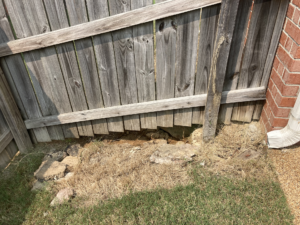
Your Gutters Collect More Water Than You May Realize
Think about the size of your roof.
Every square foot of roof collects rainwater, and your gutter system directs much of that water toward only a handful of downspouts. During one of Mobile's heavy thunderstorms, that means a large volume of water can be concentrated into a very small area.
If the downspout ends just a few inches or feet from the house, all of that water is released right beside the foundation.
The result can be:
- Washed-out soil and mulch
- Erosion around the foundation
- Standing water
- Muddy areas around the home
- Landscape damage
- Exposed roots
- Settlement of soil
- Water collecting beneath concrete
- Foundation moisture issues
- Recurring washouts after heavy rain
Adding a short splash block may help with minor runoff, but in many situations it simply isn't enough—especially when the property already has poor drainage or receives large amounts of roof runoff.
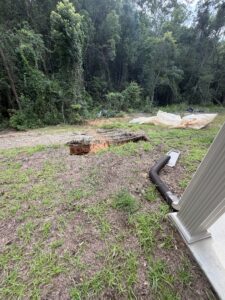
Why We Recommend Burying Downspout Extensions
A properly installed underground downspout drainage system allows us to capture water from the gutter and carry it away from the structure instead of allowing it to dump beside the foundation.
The downspout is connected to underground drainage pipe, and the system is installed with the appropriate slope to move water toward a suitable discharge location.
Depending on the property, the water may be directed toward a lower area of the yard, a daylight outlet, an approved drainage area, or another properly designed discharge point.
The goal isn't just to hide the pipe.
The goal is to control where the water goes.
A properly designed system considers the grade of the property, the amount of water being collected, pipe sizing, outlet location, existing drainage patterns, and surrounding structures.
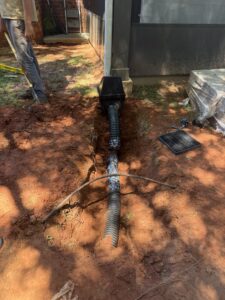
Downspout Drainage Can Help Prevent Erosion
Water follows the easiest path available.
When concentrated runoff repeatedly travels across exposed soil, it begins carrying that soil with it. A small washout can eventually turn into a much larger erosion problem.
We frequently see drainage issues where homeowners have repeatedly added topsoil, mulch, sod, or gravel to the same washed-out area without addressing the source of the water.
The repair may look good temporarily, but the next several heavy rains can wash everything away again.
Erosion control starts with controlling the water.
Redirecting gutter runoff underground can reduce the amount of concentrated surface water traveling across your landscaping and help protect areas that have repeatedly washed out.
Protecting Concrete, Driveways, Patios, and Walkways
Downspout runoff doesn't only affect your landscaping.
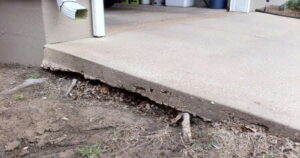
Water can also create problems around driveways, sidewalks, patios, retaining walls, and other hardscapes.
When water continually flows beside or underneath concrete, it can wash away supporting soil. Once the material underneath a slab begins eroding, voids can develop and contribute to cracking or settlement.
Similar problems can occur around retaining walls. Excess water and saturated soil can increase pressure behind a wall, particularly when adequate drainage isn't present.
This is why we look at the entire drainage system around a property, rather than treating one washed-out area in isolation.
Underground Downspouts vs. French Drains: They Do Different Jobs
This is an important distinction.
A downspout extension carries water coming directly from the roof and gutter system. Because this is concentrated water, we generally want to contain it and move it through the appropriate solid drainage pipe.
A French drain is designed to collect groundwater and surface water from saturated areas using perforated pipe, drainage stone, and geotextile.
On some properties, the correct drainage solution may involve both systems—but they don't necessarily serve the same purpose.
Simply installing a French drain without addressing downspouts that are dumping large amounts of roof water beside the house may leave a major source of the drainage problem unresolved.
Signs Your Downspouts May Need to Be Extended Underground
Take a walk around your home after the next heavy rain.
Pay particular attention to the areas where each downspout terminates.
You may need a better gutter drainage solution if you notice standing water beside your house, washed-out mulch, exposed soil, channels forming through your landscaping, water flowing across sidewalks or driveways, soggy areas that stay wet for days, soil pulling away from the foundation, or the same areas repeatedly needing new dirt, sod, gravel, or mulch.
Those symptoms may appear minor at first, but water problems rarely improve on their own.
Drainage Solutions for Mobile County's Heavy Rainfall
Drainage in South Alabama presents its own challenges.
Heavy rainfall, flat properties, saturated soils, poor grading, and intense thunderstorms can expose drainage problems very quickly. A solution that works on one property may not be appropriate for the house next door.
That's why proper residential drainage installation starts with evaluating where the water originates, how it currently travels across the property, and where it can safely be redirected.
Depending on the property, The Landscape Experts can address drainage problems using solutions such as underground downspout extensions, French drains, catch basins, grading and sloping, drainage pipe installation, erosion-control measures, aggregate, and landscape restoration.
Instead of repeatedly repairing the damage caused by water, the objective is to address the source of the problem.
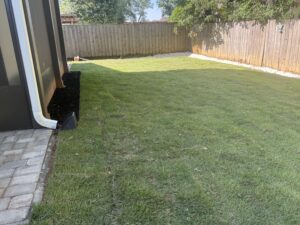
Need Downspout Drainage or Erosion Control in Mobile, Alabama?
If your gutters are dumping water beside your home, washing out your landscaping, creating standing water, or contributing to erosion, it may be time to move that water underground.
The Landscape Experts provides professional drainage and erosion-control services in Mobile County, Alabama, including Mobile, West Mobile, Semmes, Theodore, Saraland, and surrounding communities.
We can evaluate the source of the water and recommend a drainage solution designed around your property.
Whether you need buried downspout extensions, French drain installation, catch basins, grading, drainage correction, or erosion repair, our goal is simple: control the water before the water causes more damage.
Contact The Landscape Experts today to schedule an evaluation of your property's drainage needs.
